
A Beginner-Friendly Guide with Real Examples from TCS data
Introduction: Financial Statements Are Stories, Not Tables
Most people open an annual report, see pages of numbers, and close it immediately. The mistake is trying to understand everything at once.
Financial statements are not meant to be memorized. They are meant to answer simple questions about a business. Once you know which questions to ask, the numbers start making sense.
In this guide, we will learn to read financial statements step by step, using real examples from Tata Consultancy Services (TCS) so the learning stays practical.
The Three Financial Statements (With One-Line Purpose)
Every listed company publishes three core statements:
- Income Statement → Is the business profitable?
- Balance Sheet → Is the business financially strong?
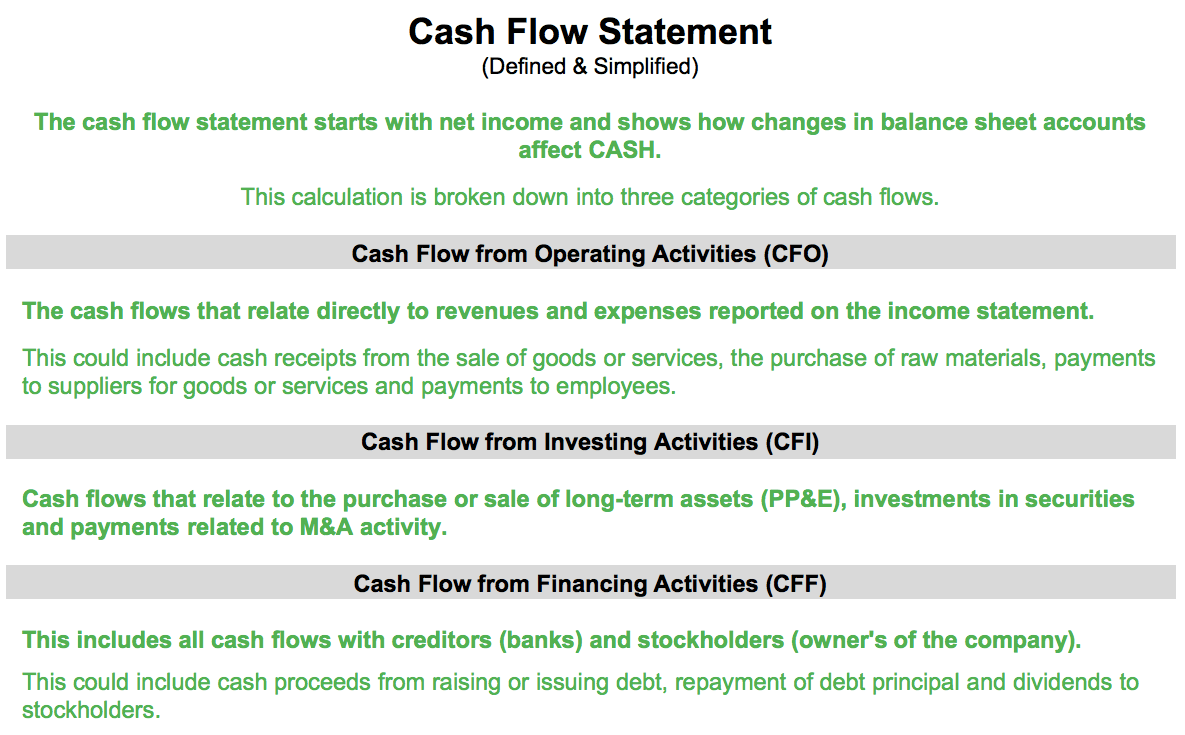
- Cash Flow Statement → Are profits real cash or just accounting entries?
You don’t need anything else to start.


1️⃣ Income Statement (Profit & Loss): Is the Business Making Money?
What the Income Statement Shows
The income statement summarizes one full year of business performance. It shows how much the company earned, how much it spent, and what was left as profit.
Think of it like a salary slip for a company, but for a full year.
Key Lines You Should Look At (Only These)
Ignore everything else initially and focus on:
- Revenue
- Operating Profit
- Net Profit
📊 TCS Income Statement Example (Simplified)
From recent annual data (rounded for understanding):
- Revenue: ~₹2.55 lakh crore
- Operating Profit: ~₹62,000 crore
- Net Profit: ~₹48,000 crore
What These Numbers Mean (In Plain English)
- For every ₹100 TCS earns, it keeps roughly ₹24 as operating profit
- After taxes and other costs, it still keeps around ₹19 as net profit
- This level of profitability is very high for a large company
👉 Interpretation:
TCS has strong pricing power and cost control.
Beginner Checkpoint
Ask yourself:
- Is revenue growing year after year?
- Are profits growing along with revenue?
- Are margins stable?
For TCS, the answer to all three is yes, which signals a strong and mature business.
2️⃣ Balance Sheet: Is the Company Financially Safe?
What the Balance Sheet Represents
The balance sheet is a snapshot of the company’s financial position on one specific date.
It answers one critical question:
Can this company survive a bad year?
Simple Balance Sheet Equation
Assets = Liabilities + Shareholders’ Equity
You don’t need to go deeper than this initially.
📊 TCS Balance Sheet Example (Simplified)
Key observations from TCS annual reports:
- Debt: Very low / negligible
- Cash & Investments: Very high
- Equity: Growing steadily year after year
What This Means in Real Life
- TCS does not depend on loans to run its business
- It has enough cash to handle downturns
- It can pay dividends without stress
👉 Interpretation:
This is what investors call a “fortress balance sheet.”
Beginner Red-Flag Example (What to Watch For)
If you see:
- Debt rising every year
- Profits growing but cash shrinking
- Equity dilution without explanation
That’s a warning sign.
TCS shows the opposite pattern, which builds trust.
3️⃣ Cash Flow Statement: Are Profits Real or Fake?
Why Cash Flow Is Crucial
A company can show profit on paper but still struggle if customers don’t pay on time.
Cash flow tells you whether money is actually entering the bank account.
Only Focus on This Section at First
- Cash Flow from Operating Activities
Ignore investing and financing sections until you are comfortable.
📊 TCS Cash Flow Example (Simplified)
For TCS:
- Operating cash flow is close to net profit
- Cash generation is consistent every year
- Dividends are paid from internal cash
What This Confirms
- Profits are genuine
- Customers pay on time
- Accounting is conservative
👉 Interpretation:
This is what separates high-quality businesses from weak ones.
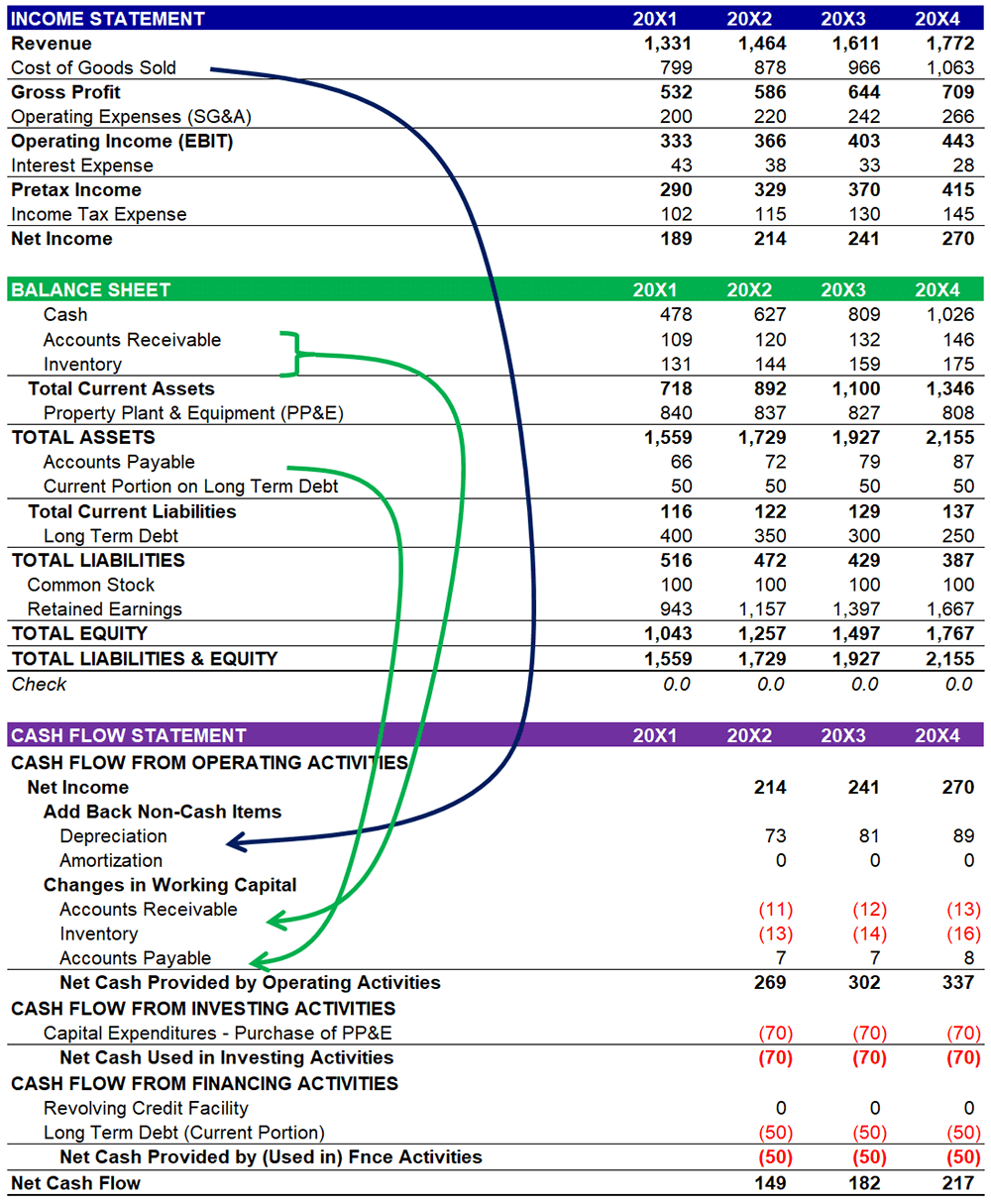
How the Three Statements Connect (Very Important)
Think of it like this:
- Income Statement → Shows performance
- Balance Sheet → Shows stability
- Cash Flow → Shows truth
A company that:
- Earns profits
- Has low debt
- Generates cash
is usually a long-term compounder.


Reading Financial Statements Over Time (Not One Year)
Never judge a company by a single year.
How Many Years to Check?
- Minimum: 5 years
- Ideal: 8–10 years
TCS Multi-Year Pattern (Simple View)
Over many years, TCS shows:
- Gradual revenue growth
- Stable margins
- Consistent cash generation
This pattern matters more than exact numbers.
Common Beginner Mistakes (With Examples)
❌ Mistake 1: Looking Only at Net Profit
Example:
A company shows ₹1,000 crore profit but has huge debt and weak cash flow.
✔ TCS check:
Profits + low debt + strong cash = healthy.
❌ Mistake 2: Ignoring Cash Flow
Example:
Profit is rising, but operating cash flow is falling.
✔ TCS check:
Profit and cash move together — a good sign.
❌ Mistake 3: Overreacting to One Bad Year
Even strong companies can have weak years.
✔ TCS check:
One slow quarter does not change the long-term story.
What You Can Ignore Initially (Safely)
When starting out, ignore:
- Complex accounting notes
- Too many ratios
- Minor line items
- Short-term market noise
Master the basics first.
A Simple Mental Model (Remember This)
If a business is genuinely good, its financial statements will look good even when simplified.
If numbers need heavy explanation to look attractive, be cautious.
Final Thoughts: Financial Statements Are Your Best Defense
Financial statements protect you from hype, tips, and emotions. They slow you down and force you to think logically.
Once you can read them comfortably, investing stops feeling risky and starts feeling structured.
At EquiDeck, every future company analysis will build on this foundation.


0 Comments